
Every Thursday, we take a trip back through curling history!
From the early days of curling on frozen ponds to corn brooms, homemade rocks, legendary players and unforgettable shots, there’s no shortage of great stories from the Roaring Game.
We’ll revisit some classic moments from the Brier, Scotties and Olympics, explore a few of curling’s more unusual traditions, and share some stories from right here at Royal City Curling Club.
Some stories will bring back memories, some might surprise you, and a few might even make you laugh.
There’s a lot of curling history out there, and every Thursday, we’ll dig up another piece of it. 🥌🥌
October 29, 2026: The Curious Origins of Sweeping
An entirely questionable tale from the Salem witch trials of 1692.
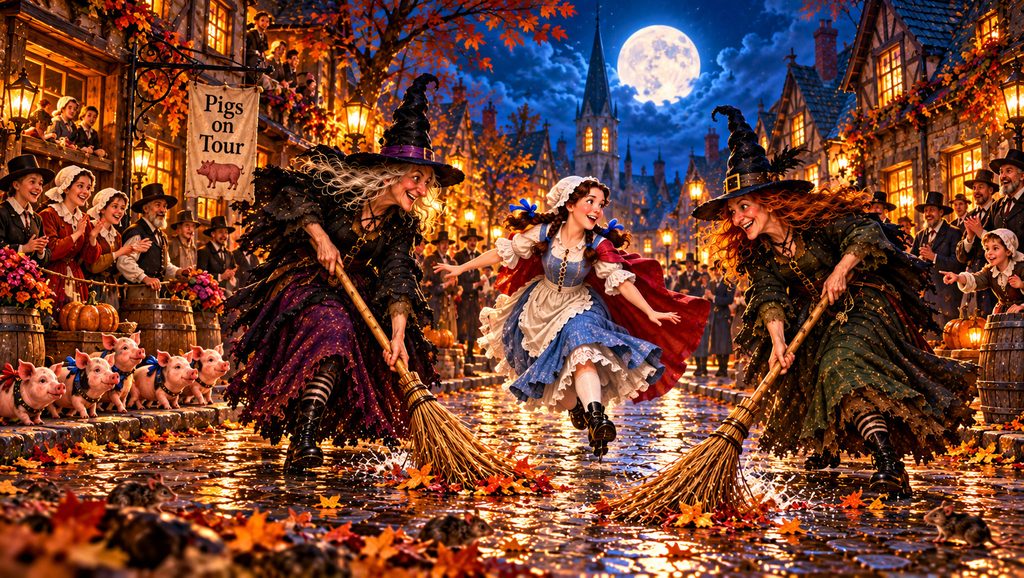
A Friday Night in Salem
It was a cold, damp Friday evening in Salem, Massachusetts, in the fall of 1692. The witch trials had everyone on edge, and the cobblestone streets were a mess. Garbage, rats, and a slippery layer of slime made getting around town an adventure in itself.
Young Abigail had somewhere important to be. She was expected at her boyfriend Skip’s house for dinner, and she was already running late.
What happened next would, quite accidentally, change the game of curling forever.
A Little Help from Above
High above Salem, two witches named Mildred and Agnes were out for an evening flight on their brooms.
Looking down, they spotted Abigail getting ready to leave her house. The streets ahead were crawling with rats and covered in garbage, so the witches decided to lend a hand.
They swooped down, took up positions on opposite sides of the street, and started sweeping toward the centre, pushing the rats and rubbish out of Abigail’s way.
The cobblestones were so slimy that Abigail barely had to move her feet. She simply glided along the freshly swept path, perfectly balanced, almost as though she were sliding down the road.
Hurry! Hurry Hard!
Mildred and Agnes were really getting into it now, their brooms scraping across the cobblestones in perfect rhythm.
The noise brought people out of their houses, and before long, both sides of the street were lined with spectators cheering Abigail on.
Even a travelling drove of pigs stopped to watch.
The pigs had arrived in Salem earlier that week, going from village to village taking part in various competitions. Nobody really knew what they were competing for, but they seemed to be having a wonderful time.
Meanwhile, Skip could see Abigail coming down the street and started calling out.
“HURRY! HURRY!”
Abigail, anxious to get to dinner, shouted to the witches:
“ALL THE WAY!”
But then she started drifting a little to one side.
“NEVER OFF!”
Mildred and Agnes put everything they had into their sweeping, determined to keep her on course.
The Line of Hogs
Just outside the butcher shop, a line of hogs stood across the street, nose to tail, waiting their turn to go inside.
Fortunately, there was a small opening right in the middle.
Abigail slid straight through without touching a single hog.
She had safely crossed the hog line!
The butcher, who had been watching from outside his shop, suddenly looked up and spotted Mildred and Agnes hovering above the street.
“WHOA!” he yelled.
Now, being caught flying around on broomsticks in Salem in 1692 wasn’t exactly good for your health.
Mildred and Agnes weren’t taking any chances.
They immediately stopped sweeping, shot straight up into the sky, and disappeared over the rooftops before anyone could get a better look.

Right on the Button
With the witches gone, Abigail was on her own for the last few yards.
She finally made it to Skip’s house, where he came rushing out to meet her.
The two embraced under the warm glow of the lantern hanging by his front door.
They looked as cute as a button.
Across the street, a Scotsman named Banjo McBroom had watched the whole thing unfold. He could hardly believe what he’d just seen.
A couple of the travelling pigs were still hanging around too, apparently enjoying the show.

The Concept of Sweeping
Banjo McBroom couldn’t get the sight out of his head.
Two witches sweeping like mad while a young lady slid down a slippery street. All that yelling and cheering, and those brooms working together like they’d been doing it for years.
There had to be a game in there somewhere!
When Banjo returned home to Scotland, he rounded up a few friends and took them out onto a frozen loch to show them what he’d seen in Salem.
Of course, he didn’t have a young lady willing to slide down a filthy street, so he used a heavy stone instead.
And rather than sweeping rats and garbage out of the way, he had his friends sweep the ice in front of the moving stone.
At first, they thought poor Banjo had gone completely mad.
But after a few tries, they were all shouting at each other and sweeping like their lives depended on it!

And that, according to this highly questionable version of history, is how sweeping became part of the roaring game.
And now you know… the rest of the story!
Editor’s Note: Abigail, Skip, Mildred, Agnes, and Banjo McBroom are entirely fictional characters. Although a few of them may bear a suspicious resemblance to certain members of our Friday Night Curling League… Paul, we’re looking at you!
This story is just a little Halloween fun. Absolutely none of it should be mistaken for actual curling history!
Join us next Thursday when we get back to some real curling history and take a look at Jam Can Curling. And yes, that one actually happened! 🥌
October 22, 2026 –Jeff Stoughton, The Man Who Put a Spin on Curling! 🥌
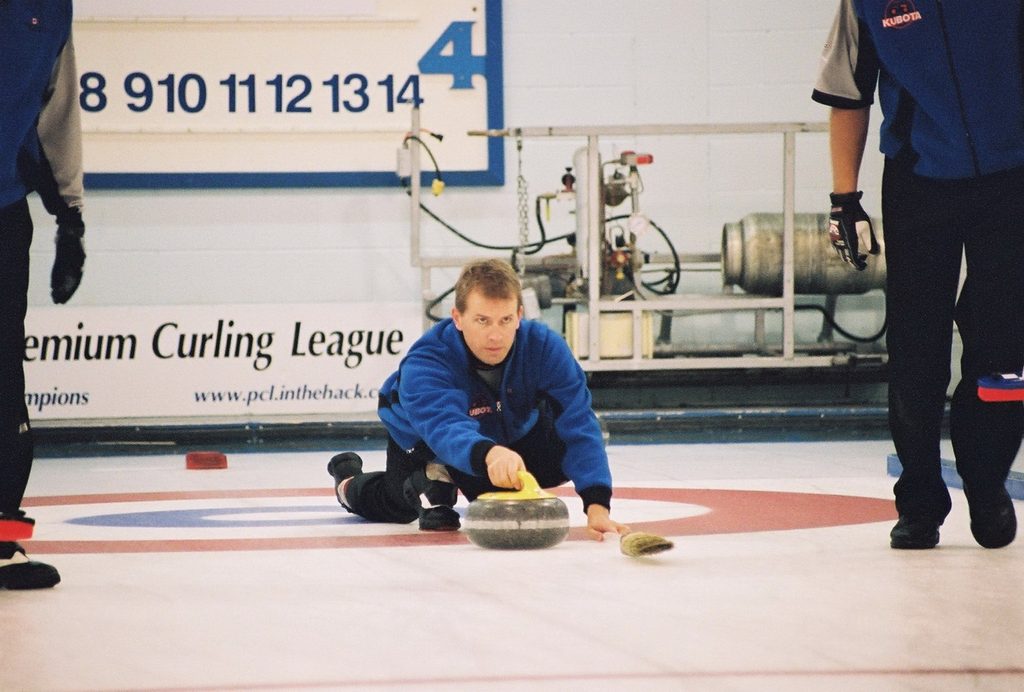
Photo: Keven McTaggart | 2003 Westcoast Curling Classic
Curling takes skill, concentration, and a steady hand. But every now and then, someone comes along who likes to have a little fun with the game.
For three-time Brier champion and two-time world champion Jeff Stoughton, that meant his famous Spin-o-Rama.
Stoughton was one of the best curlers in the game, but he also knew how to entertain a crowd. Every so often, he’d throw in his signature move, spinning a full 360 degrees before releasing his stone.
It wasn’t something you’d normally see during a curling game, but the fans loved it!
A Spin Worth Remembering
One of our own Friday Night Curling members remembers seeing Stoughton perform the Spin-o-Rama at the 1996 World Championships in Hamilton, Ontario.
It was quite something to watch in person, and one of those curling moments you don’t forget.
Little did anyone know that a few years later, the same move would end up in a movie!
From the Curling Rink to Hollywood 🎬
When the Canadian curling comedy Men with Brooms was being filmed in 2002, Jeff Stoughton showed off his famous Spin-o-Rama.
Director and star Paul Gross was so impressed that he decided to include it in the movie.
He even figured he’d give it a try himself.
Of course, spinning all the way around while delivering a curling stone is a lot harder than Stoughton made it look.
Just ask Paul Gross!
Watch Stoughton demonstrate his Spin-o-Rama, followed by Paul Gross giving it his best shot.
Video excerpt: Men with Brooms (2002).
A World Championship Spin
Stoughton wasn’t finished showing off his famous move, either!
During the 2011 World Championship final against Scotland, he treated the crowd to another Spin-o-Rama, this time on a throw-through in the seventh end.
Canada went on to capture the world title.
The Spin That Wouldn’t Quit
Even after retiring from competitive curling in 2015, Stoughton still had a few spins left in him!
At the 2017 Elite 10, he pulled out his famous Spin-o-Rama once again, and this time he even managed to put the rock remarkably close to the button!
A Champion at Royal City
Jeff Stoughton also has a bit of history right here at Royal City Curling Club!
Back in 2003, Stoughton and his team won the Westcoast Curling Classic at Royal City in New Westminster, beating Bob Ursel’s team in the championship final.
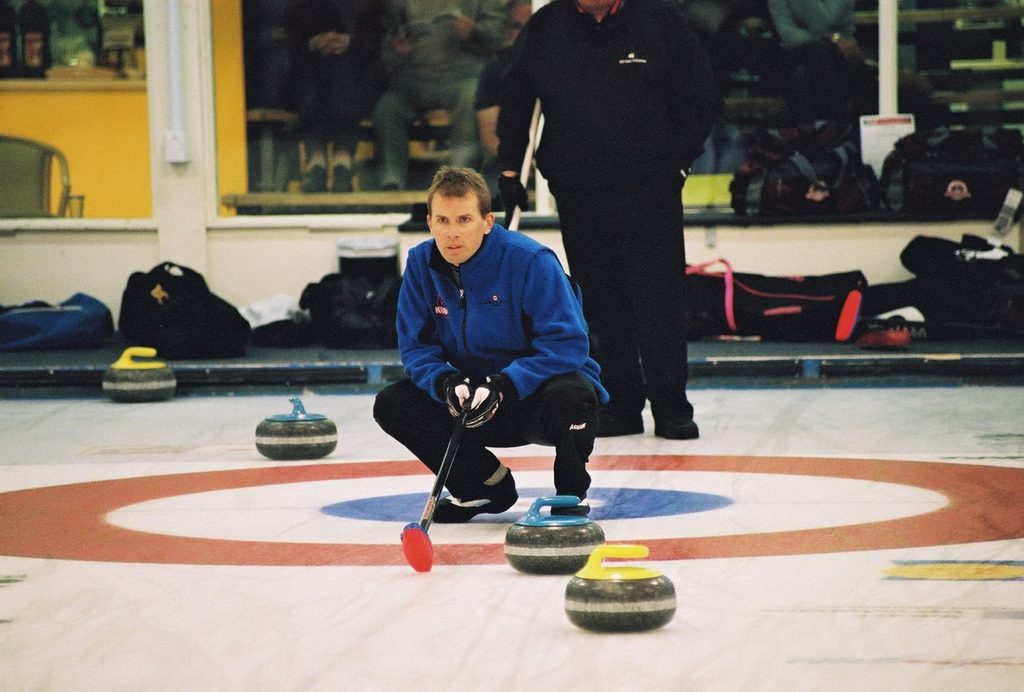
Photo: Keven McTaggart | 2003 Westcoast Curling Classic
These photos were taken at the 2003 Westcoast Curling Classic by one of our own Friday Night Curling members, who was the club photographer at the time.
It’s nice to be able to share a little piece of Royal City’s curling history from someone who was right there!
Were you at the Westcoast Curling Classic in 2003? Do you remember seeing Jeff Stoughton perform his famous Spin-o-Rama? We’d love to hear your stories!
October 15, 2026 – From Frozen Lochs to the Roarin’ Game 🥌🏴
Long before curling clubs, refrigerated ice and someone at the other end screaming “HURRY HARD!”, people were sliding stones across frozen ice.
To find the roots of our game, we have to travel back nearly 500 years to Scotland.
THE FIRST RECORDED CURLING MATCH?
The earliest known written evidence of curling comes from Paisley, Scotland, in 1540, where a record describes John Sclater, a monk at Paisley Abbey, throwing a stone along the ice as part of a challenge.
It wasn’t quite Friday Night Curling.
No pebble. No hog lines. No matching rocks.
And unfortunately, no photos. 😂
But the idea was there:
Stone + ice + competition.
BUT DID CURLING REALLY BEGIN IN SCOTLAND?
Maybe.
The exact origins aren’t completely certain. Paintings by 16th-century Flemish artist Pieter Bruegel the Elder show people playing games on frozen ponds that look remarkably similar to curling.
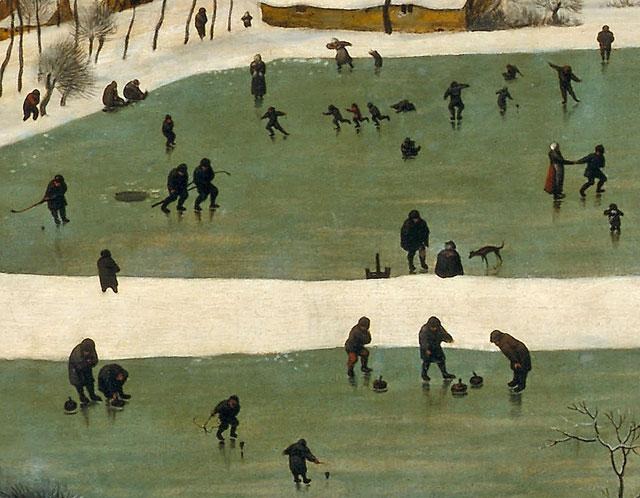
Detail from Pieter Bruegel the Elder’s Hunters in the Snow (1565). Public domain image via Wikimedia Commons.
So we may never know who slid the world’s first curling stone. What we do know is that Scotland became curling’s home, and that’s where the game developed for centuries.
THOSE ARE CURLING ROCKS? 🪨
Early curling stones looked nothing like today’s polished granite rocks.
A primitive Scottish stone dated 1511 still survives. It weighs about 26 pounds and has handholds carved directly into it. Early stones like these became known as “loofies.”
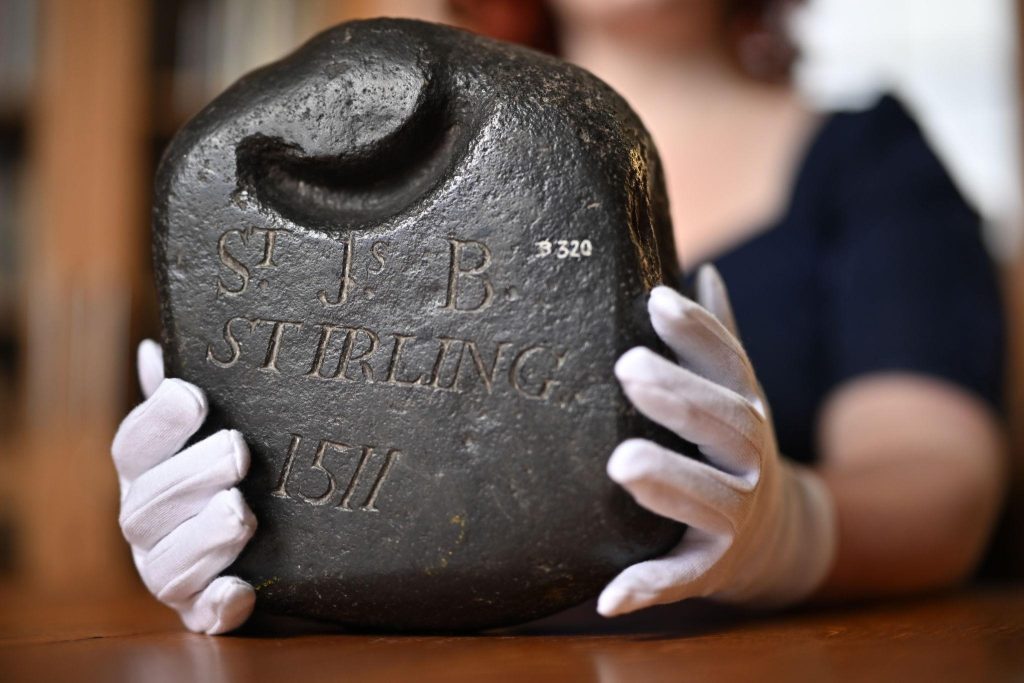
The world’s oldest known curling stone, dated 1511. The 26-pound “loofie” is held by The Smith in Stirling, Scotland. Photo courtesy of The Stirling Smith Art Gallery & Museum.
And here’s something that would make Friday night a little more difficult:
Curlers once had to bring their rocks with them.
Stones were personal or club equipment and had to be hauled to the frozen pond or loch for a match.
Imagine loading curling rocks into your car before heading to Royal City.
Suddenly carrying your broom and shoes doesn’t seem so bad. 😂
CURLING GETS ORGANIZED
For centuries, curling was played outdoors with different rules from place to place.
In 1838, the Grand Caledonian Curling Club was formed in Edinburgh and began establishing standardized rules for the game.
And when winter cooperated, the Scots knew how to hold a bonspiel. The 1848 Grand Match at Linlithgow Loch attracted roughly 680 curlers and 5,000 spectators.
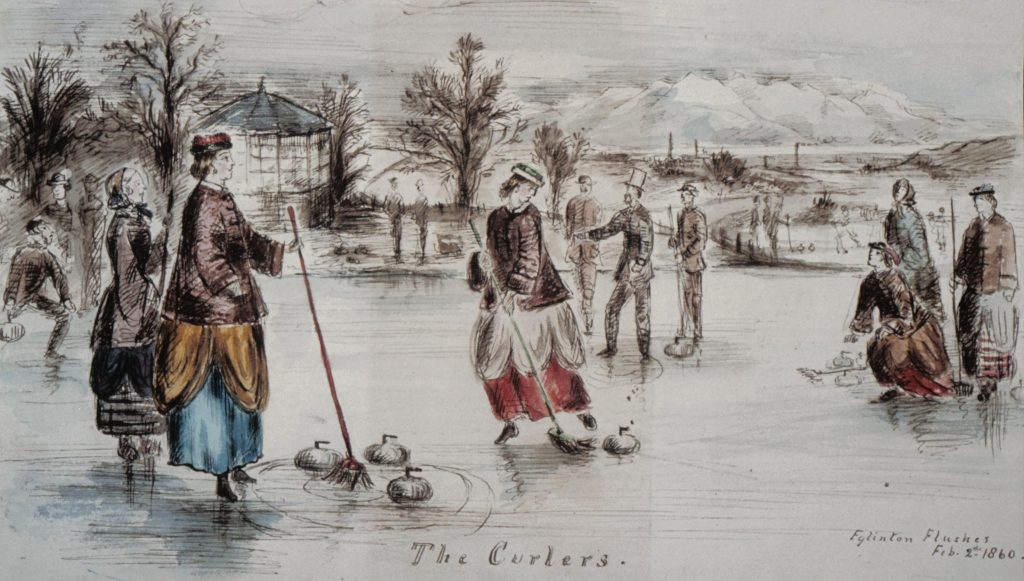
Curling at Eglinton, Ayrshire, Scotland, 1860. Public domain image via Wikimedia Commons.
Now that’s a Friday night draw. 😂
FROM SCOTLAND TO CANADA
As Scots emigrated, curling travelled with them.
The game moved indoors, equipment improved, rules became standardized, and Canada eventually became one of curling’s great homes.
Almost 500 years later, a lot has changed.
The ice is better.
The rocks are better.
The brooms are definitely better.
But the basic idea hasn’t changed much:
Slide a rock down the ice.
Get it closer than the other guy’s.
Then argue about whose fault it was when you don’t. 😂🥌
Happy Throwback Thursday!
October 8, 2026 – Corn Brooms, Cigarettes & One VERY Costly Celebration 🥌🚬
Curling looked a little different in 1972.
The brooms were made of corn. The sweaters were spectacular. And apparently nobody thought twice about throwing a rock at the World Curling Championship with a cigarette hanging out of their mouth. 😂
But the cigarette isn’t even the craziest part of this video.
This is the 1972 Air Canada Silver Broom, the men’s world curling championship, with Canada facing the United States in Garmisch-Partenkirchen, West Germany.
Going into the final end, Canada, skipped by Orest Meleschuk, trailed Bob LaBonte’s American team 8–7.
Then things got strange.
LaBonte threw what appeared to be the championship-winning shot. Thinking the United States had won, he jumped into the air to celebrate.
And accidentally kicked one of Canada’s rocks.
That displaced stone changed the result of the end. Canada scored one, tying the game and forcing an extra end.
Meleschuk’s team went on to steal the extra and win the World Championship 10–9.
The moment became one of curling’s most famous incidents, forever known as the “LaBonte Boot.”
Watch the old corn brooms, the clothes, the delivery styles and, yes, the cigarette.
Curling has changed a little in 54 years. 😂🥌
October 1, 2026 – The Story of Royal City Curling Club
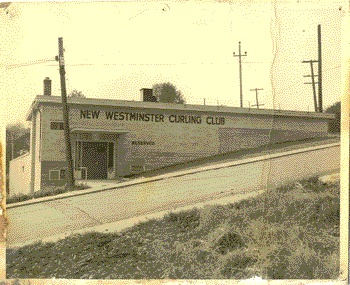
The original New Westminster Curling Club. Photo courtesy of Royal City Curling Club.
It All Started in 1955
Before there was a Royal City Curling Club, there was the New Westminster Curling Club.
The original four-sheet curling club was built in 1955 on the Scott Paper site in New Westminster. For the next ten years, it was home to the city’s curling community.
In May 1965, the building was sold to Scott Paper and converted into a warehouse. Here’s a great little piece of local history: the original building is still standing today.
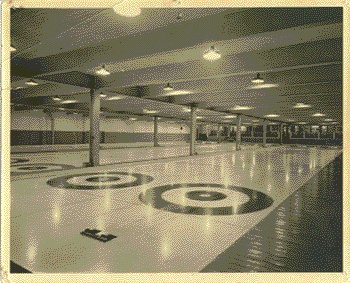
The original New Westminster Curling Club. Photo courtesy of Royal City Curling Club.
A New Home for Curling – 1965
With the original New Westminster Curling Club sold to Scott Paper, local curlers needed a new place to call home. Plans were soon underway for a new curling facility.
Construction of the new club began in August 1965. This time, the curlers were getting a much bigger home, with six sheets of ice and a large lounge overlooking the playing area.

The original New Westminster Curling Club. Photo courtesy of Royal City Curling Club.
Opening the Doors – 1966
The new Royal City Curling Club was completed in January 1966, just in time to host the annual Dogwood Bonspiel. The new six-sheet facility gave New Westminster curlers a much larger home, complete with a spacious lounge overlooking the ice.
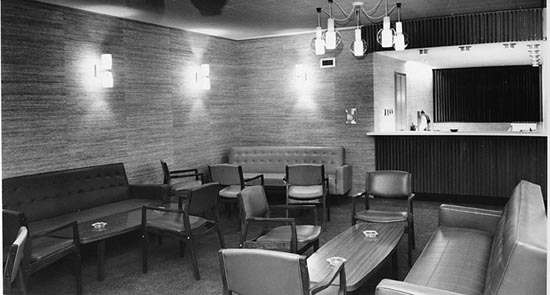
The new Royal City Curling Club lounge in 1966. Photo: Basil King (Columbian Photo), New Westminster Archives.
From New Westminster to Royal City
With the new facility came a new chapter in New Westminster curling. The Royal City Curling Club began its life in its new home, with George Reid serving as the club’s first president, Bob Kelly as its first manager, and Don Bowman as its first ice maker.
Six decades later, Royal City Curling Club is still home to generations of curlers, including all of us who take to the ice on Friday nights.